High-Impact.
Precision Results.
A precision-engineered approach to therapy. Designed for high-impact results in a monthly cadence.
Why Monthly?
For as long as therapy has been around, people have often been prescribed and encouraged to attend sessions on a weekly basis. If not, more than that. The psychology behind the weekly model is that consistency allows the therapist to get more information about the patient, get to know them better, and build momentum quicker. The ensuing regularity of weekly sessions is meant to create a routine that establishes a reliable process to teach patients how to alleviate symptoms regularly. However, this approach has some limitations that are often overlooked.
Limitations of Weekly Therapy
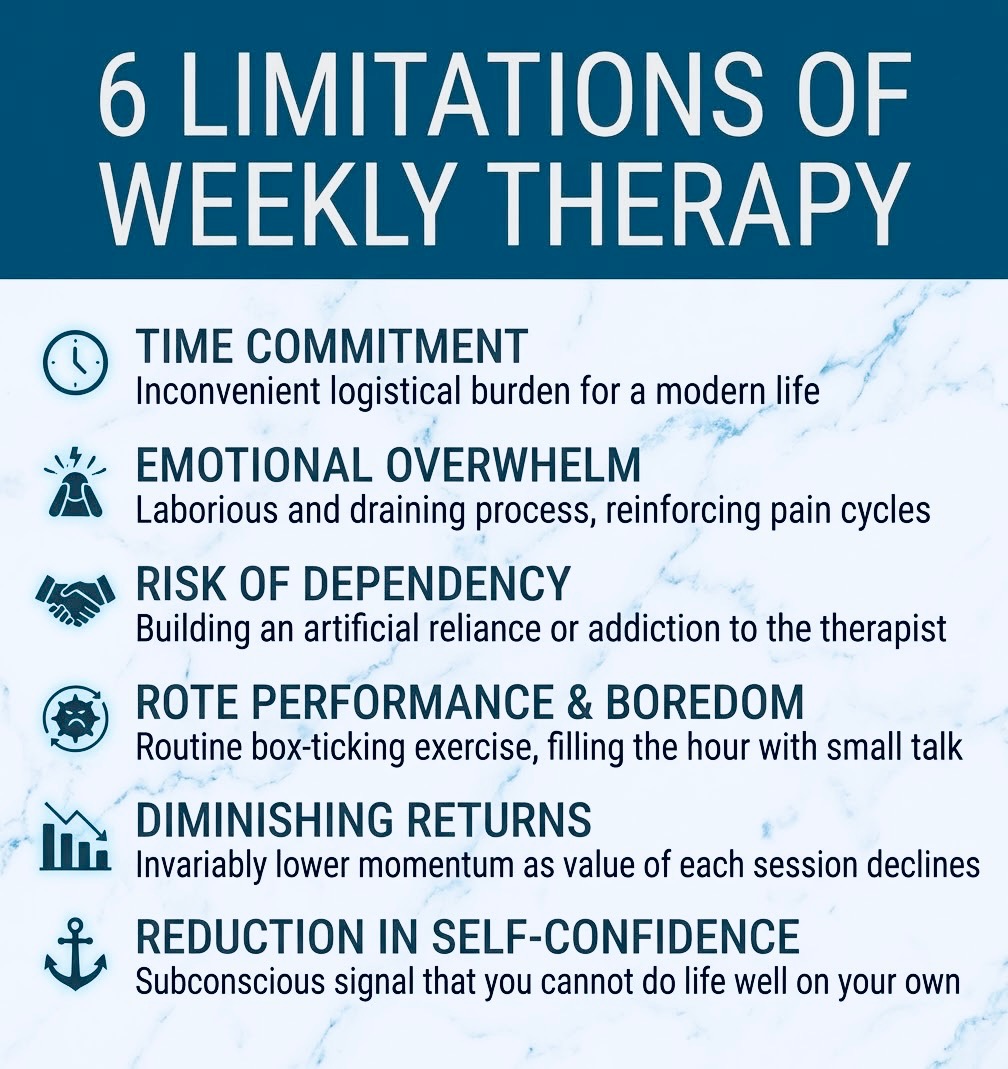
1. Time Commitment. One limitation of weekly therapy is that it requires a regular time commitment every week. For people who have a lot going on in their lives, carving out an hour each week to devote to therapy is not feasible or convenient. Today’s modern world is rife with demands at work, on the home front, and from social circles. As such, time is a precious commodity and having to allocate time every week for therapy can be too much for some.
2. Emotional Overwhelm. Another limitation of the weekly therapy model is that it can lead to patient overwhelm. When a patient opens up about certain pains or traumas, it can be emotionally burdensome to continue to process week after week. Constantly talking about the same thing over and over every week can become laborious, draining, and sometimes even unwittingly reinforcing for the patient. For example, if Jennifer keeps reliving the pain and trauma from her relationship with her mother on a regular basis, her neural pathways for that memory or dynamic will continue to get activated, creating a more solid and robust path for her to keep feeling the same thing over and over. Over time, this can wear Jennifer out, and even adversely impact her feelings towards her mother. After all, the more she attunes to it, the more she is giving it her energy.
3. Risk of Dependency. A third limitation is that regular weekly sessions can inadvertently build a reliance or dependency on the therapist. Going every week, it’s easy to get used to the routine of venting, talking, being seen and heard in a one-way container. The comfort of talking with someone who is completely devoted to you can easily become addictive, especially if you have a history of being neglected, abused, or disregarded. At that stage, the lines can get easily blurred. A patient might feel like they are done with therapy, but still continue simply because they are “just used to it,” or because they are afraid of hurting the therapist’s feelings for wanting to stop. Unconsciously, this may even lead them to create new problems just to stick around longer and keep feeling seen, heard, and valued by someone who is not in their real life, or to avoid upsetting the therapist. Or even both. In this way, staying in this paid performance of intimacy longer than needed can become misleading and counter-productive.
4. Rote Performance and Boredom. A fourth limitation of weekly sessions is the possibility of rote performance. More is not always better. When you are forced to show up every week regardless of your internal state, therapy can lose its “edge” and become a routine box-ticking exercise. The sessions can become a place to “fill the hour” with small talk or superficial updates because you feel obligated to perform the ritual of therapy. This can create a chronic, low-level boredom that undermines the intensity for real change to occur. Instead of being a catalyst for breakthroughs, the weekly rhythm can become a flat, repetitive background noise in your life.
5. Diminishing Returns. A fifth limitation is that an emphasis on regular weekly sessions can yield a routine that can often lead to diminishing returns on the value of each session. When the emphasis is to go in such short intervals, regardless of need or urgency, the individual value of these sessions invariably decline. The quality of the sessions are often not the same, and you’re still paying the same for them, nevertheless.
6. Reduction in Self-Confidence. Finally, another limitation is that going to therapy every week can subconsciously send patients the message that they “need” the therapist every week in order to succeed in their life, or to simply stay afloat. This can reduce their self-confidence, or belief in themselves that they can do life well without therapy. Because of this, patients might unknowingly start to believe that there is something wrong with them that they must keep going to therapy every week.
Instead of the weekly therapy model, high-impact therapy just once a month could get you better results, in less time, for less money. I’m not talking about maintenance therapy after being in therapy for years here. What I’m referring to is a therapy model that starts on a monthly cadence. Here are some benefits to this approach.
Advantages of a High-Impact Monthly Model
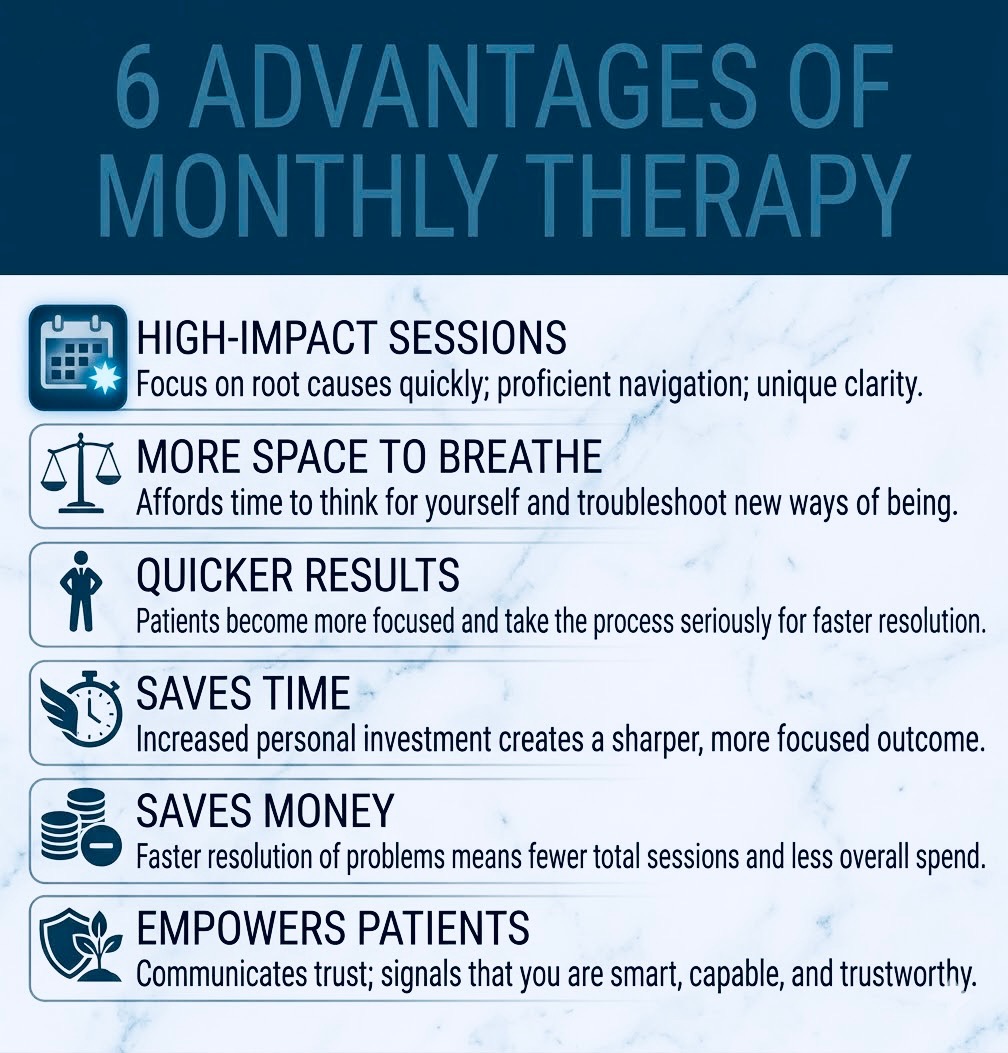
1. High-Impact. When therapy is high-impact and starts with an expressed frequency of once per month, this places a premium on the efficiency of the process. At this stage, the psychologist has the responsibility to be sharp and on-point. This means the psychologist must be able to identify root causes of the patient’s issues quickly, understand how to navigate them proficiently, and offer unique clarity and insight early on that will borderline make the patient go, “Whoah, that’s right. I never it saw it like that.” This sets the patient up for a powerful win. In other words: Things get real. Fast.
2. More Space to Breathe. The nature of high-impact therapy is that it can be very potent. In order to accomplish this potency, insights come faster. Depending on the insights, these can take time to process and digest. The beauty of having weeks of space between sessions is that it affords the patient the opportunity to really think about what they learned, possibly troubleshoot new ways of being in their lives, and not feel pressured that they have to “report back” in a week if they are not ready to. The time gives them the liberty to think for themselves for longer, and more patiently decide what they want to do next before meeting again.
3. Quicker Results. When patients are in a higher-impact experience and know that they are allowed to have several weeks between sessions, they are more likely to listen more carefully in sessions. Automatically, this raises their focus and prompts them to absorb content more carefully than they otherwise would because every minute suddenly becomes scarce. Often, this can motivate patients to take the process more seriously, and do what they need to do to resolve their issues quicker.
4. Saves Time. Naturally, when a patient is more focused in sessions, and is driven to apply appropriate solutions in their real life more seriously, they are going to get resolutions to their problems faster. That increased personal investment creates a sharper, more focused outcome. For example, if Michael goes to therapy for $250/hour once a week for a month, he will have spent 4 hours and $1,000 in a month. However, if Michael pays $1,000/hour once a month, and he gets at least the same amount of knowledge and insight, if not more, than 4 sessions at $250/hour, he just saved 3 hours of his life! That’s 3 more hours of freedom and autonomy a month with the same, if not more, information.
5. Saves Money. Quicker clarity and insight, and faster resolutions of problems mean less time in therapy. Less time in therapy overall means you save more money.
- The Mid-Tier Comparison: If Catherine goes to traditional weekly therapy for $200/hour for 24 weeks, she spends $4,800. If she achieves the exact same result or better in just one precision-engineered session at $1,000/hour, she saves $3,800 and gets her life back 23 weeks sooner.
- The High-End Comparison: If she sees a high-end weekly therapist at $600/hour, she spends $2,400 every single month. By switching to a precision model at $1,000/hour only once a month, if she achieves the exact same or better results, she saves $1,400 a month while gaining sharper knowledge and deeper insights.
6. Empowers Patients. Knowing that you don’t have to be in therapy every week sends a powerful message to your subconscious: you can do life well on your own, if you need more help you simply ask for it. In essence, the therapist is signaling to the patient that they trust them. By leading with a once per month model, patients are receiving the message that they are smart, capable, and trustworthy. If they need more help, they are competent enough to ask for more. The truth is patients are often more intelligent, adept, and able than the mental health field traditionally gives them credit for.
Why Monthly Therapy Works
1. Discerning Psychologist. The high-impact monthly therapy model only works if a psychologist is exceptionally discerning and knows what they’re talking about. They must be able to read a situation quickly, break things down effectively, and communicate the information simply. They have to deliver what they see in a way that speaks to the patient’s heart and soul organically and efficiently. When a patient thinks, “Wow, how did you know that so quickly?” everyone wins.
2. Motivated Patient. The high-impact monthly model is an arrangement that requires more than just a discerning psychologist. It demands a motivated patient who doesn’t want to be in therapy forever. The model is most effective for individuals who are ready to be open, transparent, and courageous in their self-reflection. And to be willing to look at their issue from a new vantage point because they really want their life to improve. When you approach sessions with this level of intent and drive, the potential for breakthroughs is exponentially higher.
3. Engineered Differently. If you are already spending around $250 a week on traditional therapy, you are already investing $1,000 a month in your mental health. The question is: Are you getting $1,000 worth of results? By the physics of it all, four sessions at $250 each are rarely capable of delivering $1,000 worth of clinical value.
4 low-impact sessions do not equal 1 high-impact session.
4 Lexuses do not equal 1 Lamborghini. They are built differently. Structured differently. Operate differently.
In depth. Precision. Performance.